
Port 25 Restrictions Explained: Why Cloud Email Verifiers Can’t Be Unlimited
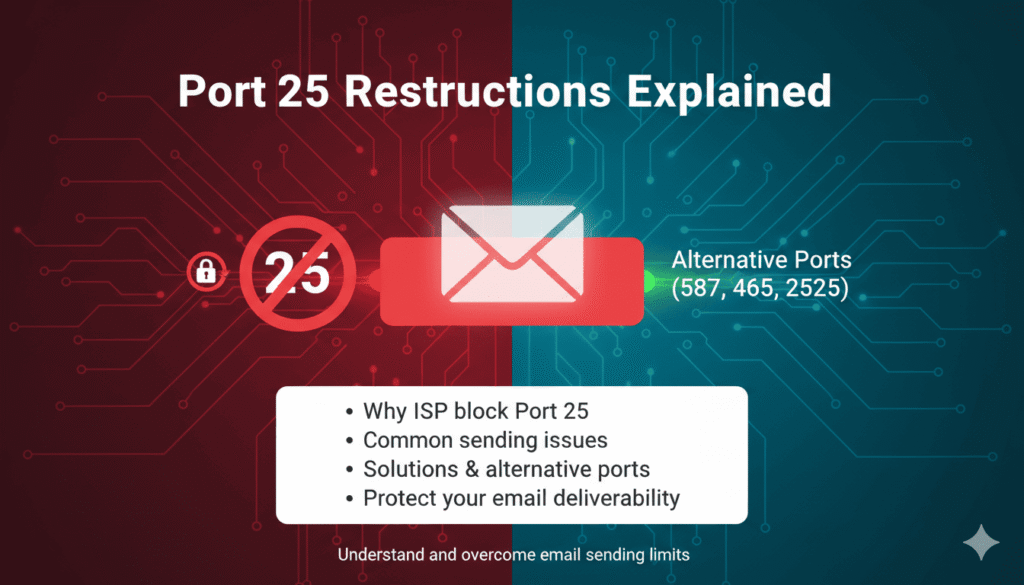
Cloud-based email verification services promising unlimited checks often hide a critical technical limitation that affects accuracy and reliability. Port 25 restrictions imposed by major cloud providers like AWS, Google Cloud, and Microsoft Azure fundamentally limit how email verification works in cloud environments. Understanding these restrictions helps you evaluate verification services realistically and choose providers that deliver actual results rather than marketing promises.
This technical guide explains what port 25 restrictions are, why cloud providers implement them, and how they impact email verification services. Furthermore, you’ll discover why truly unlimited cloud-based verification remains technically impossible and learn to identify providers using workarounds that compromise verification quality. Whether you’re choosing a verification service or building your own solution, these insights reveal the infrastructure realities behind email verification.
What is SMTP Port 25?
SMTP port 25 serves as the standard communication channel for mail servers exchanging email messages across the internet. Simple Mail Transfer Protocol uses this port for server-to-server mail delivery, making it fundamental to email infrastructure worldwide. Every email you send travels through port 25 at some point during delivery, even if your email client uses different ports.
The Internet Assigned Numbers Authority designated port 25 for SMTP in 1982, establishing it as the default port for mail transfer. Consequently, mail servers expect incoming connections on port 25 when receiving messages from other servers. This standardization enables the global email system to function seamlessly across different providers and platforms.
How Port 25 Works in Email Communication
When you send an email, your message travels through multiple servers before reaching its destination. Your email client connects to your outgoing mail server using port 587 or 465. However, that server then connects to the recipient’s mail server using port 25 to deliver the message. This server-to-server communication via port 25 completes the delivery chain.
Mail servers listen on port 25 for incoming connections from other legitimate mail servers. They accept these connections, verify sender credentials through various authentication mechanisms, and receive the email message. Therefore, port 25 access remains essential for any system that needs to communicate directly with mail servers.
The protocol operates through a series of commands and responses between sending and receiving servers. According to RFC 5321, the SMTP specification, servers exchange HELO/EHLO greetings, MAIL FROM commands, RCPT TO commands, and finally the message data. This standardized conversation enables reliable message transfer across heterogeneous systems.
The Role of Port 25 in Email Verification
Email verification services rely on port 25 to check whether email addresses actually exist. The verification process connects to the recipient’s mail server via port 25 and simulates the beginning of an email delivery. By analyzing the server’s responses to RCPT TO commands, verification systems determine whether the mailbox exists without actually sending a message.
This technique, called SMTP validation or mailbox verification, provides the most accurate method for confirming email address validity. Alternative verification methods like syntax checking or domain validation can’t confirm whether a specific mailbox exists. Only direct server queries via port 25 reveal whether “john@example.com” represents an active, receiving mailbox.
The verification conversation follows standard SMTP protocol but stops before transmitting message data. The verifier connects, identifies itself, specifies a sender address, then attempts to specify the recipient address. If the receiving server accepts the recipient, the address is valid. If it rejects the recipient, the address doesn’t exist or can’t receive mail.
| Verification Step | SMTP Command | Purpose |
|---|---|---|
| Connect to mail server | TCP connection on port 25 | Establish communication channel |
| Identify verifier | EHLO/HELO domain.com | Announce sending server |
| Specify sender | MAIL FROM: verify@domain.com | Identify message origin |
| Test recipient | RCPT TO: user@example.com | Check if mailbox exists |
| Disconnect | QUIT | Close connection cleanly |
Why Cloud Providers Block Port 25
Major cloud infrastructure providers implement strict port 25 restrictions to combat spam and protect their network reputation. These restrictions didn’t exist in early cloud computing but became necessary as spammers increasingly abused cloud resources. Understanding the reasons behind these policies reveals why they’re unlikely to change and why verification services must work within these constraints.
The Spam Problem That Changed Everything
Spammers discovered that cloud infrastructure offered cheap, scalable resources for mass email campaigns. They could spin up hundreds of virtual machines, send millions of spam messages through port 25, and abandon the instances when blacklisted. This abuse pattern created serious problems for cloud providers and their legitimate customers.
According to Amazon Web Services documentation, spam activity from their infrastructure led to AWS IP addresses appearing on multiple blacklists. These blacklists affected all AWS customers, even those conducting legitimate email operations. Therefore, AWS began throttling and blocking port 25 traffic by default in 2006.
The spam volume from cloud infrastructure grew exponentially as services became more accessible. Cloud providers found themselves in constant battles with blacklist operators who blocked entire IP ranges. Legitimate customers suffered collateral damage as their messages landed in spam folders or bounced entirely due to blacklisted sending IPs.
Industry-Wide Security Standards
Port 25 blocking evolved into an industry best practice extending beyond spam prevention. Security organizations recognized that open port 25 access creates risks including compromised instances sending spam, botnet command and control communication, and email-based malware distribution. Consequently, blocking port 25 became a standard security recommendation.
The Cloud Security Alliance and other industry groups formally recommend blocking outbound port 25 in cloud environments. These recommendations influence cloud provider policies and customer security configurations. Moreover, many enterprise security frameworks now require port 25 restrictions as part of baseline security controls.
Internet service providers adopted similar policies for residential connections years earlier. Most consumer ISPs block outbound port 25 to prevent compromised home computers from sending spam. Cloud providers simply extended this proven approach to their infrastructure, recognizing similar abuse patterns in cloud environments.
Which Cloud Providers Block Port 25?
Nearly every major cloud infrastructure provider implements some form of port 25 restriction. While specific policies vary, the overall trend remains consistent across the industry. Understanding each provider’s approach helps you evaluate where email verification infrastructure can and cannot operate effectively.
Amazon Web Services (AWS) Port 25 Policy
AWS throttles outbound port 25 connections by default on all EC2 instances. This throttling severely limits the number of connections possible, making high-volume email operations impractical. However, AWS does offer a process for requesting port 25 restriction removal for legitimate use cases.
The removal request process requires detailed justification, proof of legitimate email sending needs, and compliance with AWS email policies. AWS reviews each request manually and frequently denies applications they consider risky. Even approved requests come with strict monitoring and can be revoked if abuse occurs.
Approved customers must implement proper authentication, maintain low complaint rates, and monitor bounce rates carefully. AWS actively monitors email sending from instances with port 25 access and will re-impose restrictions if they detect problems. Therefore, the approval process alone doesn’t guarantee sustainable email operations.
- Default status: Throttled on all EC2 instances
- Removal request: Manual review process required
- Approval rate: Selective, many requests denied
- Monitoring: Continuous surveillance of approved accounts
- Revocation: Access can be removed without notice
Google Cloud Platform Port 25 Restrictions
Google Cloud Platform blocks outbound port 25 connections entirely with no exceptions. Unlike AWS, GCP doesn’t offer any process for requesting port 25 access removal. This absolute restriction reflects Google’s strict anti-spam stance and their determination to maintain infrastructure reputation.
According to Google Cloud’s official documentation, customers needing to send email must use alternative ports like 587 or 465, or route through third-party email services. This policy applies to all instance types and configurations without exception.
The permanent restriction makes GCP infrastructure unsuitable for email verification services requiring direct SMTP validation. Services hosted on GCP must use alternative verification methods or proxy connections through external infrastructure. This limitation affects both accuracy and cost for verification operations.
Microsoft Azure Port 25 Limitations
Microsoft Azure blocks outbound port 25 by default but allows removal requests under specific circumstances. However, Azure’s approval process is notably stricter than AWS, with higher requirements for justification and compliance documentation. Additionally, only certain subscription types qualify for port 25 access.
Enterprise Agreement and MSDN subscription holders receive more favorable consideration for port 25 access. Pay-as-you-go and trial subscriptions face significantly higher barriers. Azure requires detailed technical documentation, abuse prevention measures, and often proof of prior email sending history.
Even approved Azure customers face ongoing monitoring and compliance requirements. Microsoft reserves the right to revoke port 25 access if they detect policy violations, excessive bounces, or spam complaints. The revocation can occur without prior warning, potentially disrupting email operations.
Other Major Cloud Providers
DigitalOcean, Linode, Vultr, and other popular cloud providers implement similar port 25 restrictions. Most block or throttle port 25 by default, requiring manual intervention for access. The specific policies vary, but the overall industry trend remains consistent toward restricting direct SMTP access.
| Cloud Provider | Port 25 Status | Removal Process | Approval Difficulty |
|---|---|---|---|
| AWS | Throttled | Request form available | Moderate to High |
| Google Cloud | Blocked | No removal available | Impossible |
| Microsoft Azure | Blocked | Support ticket required | High |
| DigitalOcean | Blocked | Support ticket required | Moderate |
| Linode | Blocked | Support ticket required | Moderate |
Smaller or newer cloud providers may offer more permissive port 25 policies initially. However, as they grow and face spam issues, they typically implement restrictions similar to major providers. Therefore, building email infrastructure on permissive providers carries risk of future policy changes.
How Port 25 Restrictions Affect Email Verification
Port 25 restrictions fundamentally limit cloud-based email verification capabilities. Services operating entirely in restricted cloud environments cannot perform comprehensive SMTP validation, the most accurate verification method. Understanding these technical limitations helps you evaluate verification service claims realistically.
The Technical Impact on Verification Accuracy
SMTP validation via port 25 represents the gold standard for email verification accuracy. This method directly queries mail servers to confirm mailbox existence, providing verification rates exceeding 95 percent accuracy. Alternative methods like syntax checking, DNS validation, or disposable email detection achieve only 60 to 80 percent accuracy.
Services unable to access port 25 must rely on these inferior verification methods. They can check email syntax, verify domain DNS records, and identify known disposable services. However, they cannot confirm whether “john@gmail.com” represents an actual receiving mailbox versus a non-existent address with valid syntax and domain.
The accuracy gap becomes particularly problematic for large lists where even small percentage differences matter. A verification service with 80 percent accuracy versus 95 percent accuracy means an additional 15 percent of addresses remain unverified. For a 100,000-contact list, that’s 15,000 potentially invalid addresses causing bounces and reputation damage.
- SMTP validation (port 25): 95-98% accuracy
- DNS + syntax validation: 75-85% accuracy
- Syntax validation only: 60-70% accuracy
- Database matching: 50-65% accuracy
Why Unlimited Cloud Verification is Impossible
Services claiming unlimited email verification while operating on major cloud platforms face an impossible contradiction. Port 25 restrictions make high-volume SMTP validation impractical in cloud environments. Therefore, truly unlimited verification requires either non-cloud infrastructure or acceptance of lower-accuracy verification methods.
Some services attempt to work around restrictions by rotating through multiple cloud accounts or providers. This approach creates significant operational complexity, increases costs, and still faces scalability limits. Moreover, it violates most cloud provider terms of service, risking account termination and service disruption.
The economics further expose the impossibility of unlimited cloud verification. Real SMTP validation requires dedicated infrastructure, IP address management, and careful reputation maintenance. These costs scale with verification volume, making true “unlimited” plans financially unsustainable for providers charging reasonable fees.
Research from Validity’s email verification analysis shows that services offering unlimited verification typically use cached results, simplified validation, or rate limit users through other means. The “unlimited” claim serves as marketing rather than technical reality.
Alternative Ports and Their Limitations
Email communication uses several ports beyond port 25 for different purposes. Understanding these alternatives and why they don’t solve port 25 restrictions reveals the fundamental nature of the limitation. While alternatives work for sending email, they cannot replace port 25 for verification purposes.
Port 587 and Port 465 Explained
Port 587 serves as the standard submission port for email clients sending messages to their mail server. This port requires authentication, making it suitable for user-to-server communication but not server-to-server transfer. Email clients like Outlook, Gmail, and Apple Mail use port 587 to submit outgoing messages.
Port 465 originally designated for SMTPS (SMTP over SSL) provides encrypted email submission. Like port 587, it requires authentication and serves client-to-server communication. Modern email configurations typically use port 587 with STARTTLS encryption rather than port 465, though both remain functional.
Mail servers accept connections on these ports from authenticated users submitting email. However, they don’t accept connections from other mail servers attempting to deliver messages. Therefore, these ports work for sending email through a service but not for direct server-to-server communication required in verification.
| Port | Purpose | Authentication | Verification Use |
|---|---|---|---|
| 25 | Server-to-server mail transfer | Optional (SPF/DKIM) | Required for SMTP validation |
| 587 | Mail submission (SMTP) | Required | Not suitable |
| 465 | Mail submission (SMTPS) | Required | Not suitable |
| 2525 | Alternative submission | Required | Not suitable |
Why Alternative Ports Don’t Solve the Problem
Email verification requires connecting to arbitrary mail servers across the internet to query mailbox existence. These destination mail servers expect incoming connections on port 25, not alternative ports. Attempting to connect via port 587 or 465 to a random mail server fails because those ports require authentication credentials the verifier doesn’t have.
Some verification services claim to use “alternative methods” or “proprietary technology” to bypass port 25 restrictions. In reality, they’re simply skipping SMTP validation entirely and relying on less accurate methods. No legitimate technical workaround exists for connecting to mail servers without port 25 access.
The architectural design of email infrastructure makes port 25 irreplaceable for server-to-server communication. While IETF standards committees have discussed alternatives, no viable replacement protocol has achieved widespread adoption. Therefore, port 25 remains fundamental to email delivery and verification for the foreseeable future.
Working Around Port 25 Restrictions
Legitimate email verification services must implement infrastructure solutions that provide port 25 access while maintaining quality and compliance. These approaches require significant investment but enable accurate verification at scale. Understanding these solutions helps you evaluate whether a verification provider has the infrastructure to deliver promised results.
Dedicated Server Solutions
Dedicated servers or colocation hosting provide unrestricted port 25 access because providers don’t impose cloud-style limitations. Services using dedicated infrastructure can perform full SMTP validation without throttling or blocking. However, this approach requires substantial investment in hardware, network connectivity, and ongoing maintenance.
Quality verification providers maintain dedicated server infrastructure specifically for SMTP validation. They manage IP address reputation carefully, implement proper reverse DNS, and monitor sending patterns. This infrastructure investment explains why legitimate verification services charge per-verification rather than offering truly unlimited plans.
Hybrid approaches combine cloud infrastructure for application hosting with dedicated servers for verification operations. The application runs in scalable cloud environments while verification requests route to dedicated SMTP validation servers. This architecture balances scalability with verification accuracy but increases operational complexity.
- Unrestricted port 25 access for SMTP validation
- Complete control over IP reputation management
- Consistent, predictable verification performance
- No risk of cloud provider policy changes
- Ability to scale verification volume as needed
Hybrid Verification Approaches
Sophisticated verification services layer multiple validation methods to maximize accuracy within infrastructure constraints. They perform syntax validation, DNS checks, and disposable email detection in cloud environments. Then they route addresses requiring SMTP validation to dedicated infrastructure with port 25 access.
This layered approach optimizes costs while maintaining accuracy. Simple validations that don’t require port 25 process quickly in cloud infrastructure. Complex validations requiring server queries route to dedicated systems. The combination achieves high accuracy while managing infrastructure expenses efficiently.
Some providers partner with third-party SMTP validation services rather than maintaining dedicated infrastructure themselves. This approach reduces capital investment but creates dependencies and ongoing costs. Moreover, it may limit verification volume or introduce delays compared to owned infrastructure.
What This Means for Verification Service Users
Port 25 restrictions create a clear divide between verification services that can deliver accurate results and those making unrealistic promises. Educated buyers can identify quality providers by understanding the infrastructure requirements behind effective verification. This knowledge protects you from wasting money on services that cannot deliver promised accuracy.
How to Identify Quality Verification Providers
Legitimate verification services transparently discuss their verification methods and infrastructure. They explain how they perform SMTP validation despite port 25 restrictions, typically through dedicated infrastructure investments. Services that avoid technical details or claim proprietary solutions often lack proper infrastructure.
Check whether providers specify their verification method accuracy rates. Quality services distinguish between different validation types and admit when SMTP validation isn’t possible for certain domains. Providers claiming 99 percent accuracy across all addresses likely exaggerate or misunderstand verification limitations.
Review pricing structures for realism. Services offering unlimited verification for low monthly fees cannot afford the infrastructure required for accurate SMTP validation. Real verification costs scale with volume due to infrastructure requirements. Therefore, reasonable per-verification or volume-tiered pricing indicates legitimate operations.
- Transparent explanation of verification methods
- Realistic accuracy claims (95-98% for SMTP validation)
- Volume-based or per-verification pricing
- Clear documentation of infrastructure approach
- Honest about verification limitations
- References to dedicated SMTP infrastructure
Red Flags in Verification Service Claims
Be skeptical of services claiming unlimited verification while operating entirely in cloud environments. The port 25 restrictions make this technically impossible without sacrificing verification accuracy. Similarly, extremely low pricing that seems too good to be true usually indicates simplified validation methods rather than comprehensive SMTP checking.
Watch for vague descriptions of verification technology. Terms like “proprietary AI algorithms” or “advanced cloud validation” often disguise the absence of actual SMTP validation. Legitimate services clearly state they perform SMTP validation and explain how they access port 25.
Services refusing to provide sample verification reports or API documentation may hide accuracy issues. Quality providers offer detailed examples showing exactly what information they return and how they classify different address types. Transparency in reporting indicates confidence in verification quality.
| Claim | Reality | Red Flag Level |
|---|---|---|
| “Unlimited cloud verification” | Impossible with port 25 restrictions | High |
| “99.9% accuracy guaranteed” | Unrealistic across all address types | High |
| “Proprietary AI validation” | Likely avoiding SMTP validation | Medium |
| “Verify millions instantly” | Suggests cached/database results | Medium |
| “$5/month unlimited” | Cannot cover SMTP infrastructure costs | High |
The Future of Email Verification Infrastructure
Port 25 restrictions will likely persist and potentially expand as cloud providers maintain strict anti-spam policies. No industry movement suggests relaxation of these limitations. Therefore, verification services must continue investing in dedicated infrastructure or accepting accuracy limitations from alternative methods.
Emerging technologies like authenticated sender frameworks and universal email validation protocols could eventually provide alternatives to SMTP validation. However, these technologies require industry-wide adoption and fundamental changes to email infrastructure. Such transformations typically take decades, making port 25 restrictions relevant for the foreseeable future.
The growing importance of email deliverability and sender reputation will likely increase demand for accurate verification services. This demand favors providers with proper infrastructure investments over cheap, inaccurate alternatives. Consequently, the verification market may consolidate around providers capable of maintaining dedicated SMTP validation infrastructure.
According to Gartner’s research on email security, email volume continues growing despite predictions of email’s decline. This growth ensures continued relevance of verification technology and infrastructure requirements. Services that invest in proper infrastructure now position themselves for long-term success.
Frequently Asked Questions About Port 25 Restrictions
What is port 25 used for?
Port 25 serves as the standard communication channel for SMTP server-to-server email transmission. Mail servers use this port to deliver messages to recipient servers across the internet. Additionally, email verification services use port 25 to query mail servers and confirm whether specific email addresses exist. No other port can replace port 25 for direct mail server communication and verification purposes.
Why do cloud providers block port 25?
Cloud providers block port 25 primarily to combat spam and protect their infrastructure reputation. Spammers historically abused cloud resources to send massive spam volumes, causing cloud provider IP addresses to appear on blacklists. These blacklists affected all customers, forcing providers to implement port 25 restrictions. Additionally, blocking port 25 prevents compromised instances from sending spam and reduces overall security risks.
Can I request port 25 access from AWS?
Yes, AWS offers a removal request process for port 25 restrictions through their support system. However, AWS manually reviews each request and frequently denies applications they consider risky. You must provide detailed justification, demonstrate legitimate email sending needs, and commit to compliance with AWS email policies. Even approved requests face ongoing monitoring and can be revoked if AWS detects policy violations or abuse.
Does Google Cloud Platform allow port 25 access?
No, Google Cloud Platform blocks outbound port 25 connections entirely with no exceptions or removal process. GCP customers needing to send email must use alternative ports like 587 or 465, or route through third-party email services. This absolute restriction reflects Google’s strict anti-spam stance and makes GCP infrastructure unsuitable for services requiring direct SMTP validation.
How do email verification services work without port 25?
Verification services without port 25 access must rely on less accurate methods like syntax validation, DNS record checking, and disposable email detection. These methods achieve only 60 to 80 percent accuracy compared to 95 percent or higher for SMTP validation via port 25. Some services maintain dedicated server infrastructure outside cloud environments to access port 25 for accurate verification.
What’s the difference between port 25 and port 587?
Port 25 handles server-to-server email transfer and requires no authentication from other mail servers. Port 587 serves as the submission port for email clients sending to their mail server and requires authentication. Mail servers accept connections on port 587 only from authenticated users, not from other servers attempting delivery. Therefore, port 587 cannot replace port 25 for verification or server-to-server communication.
Are unlimited email verification services legitimate?
Services offering truly unlimited verification while operating in cloud environments face technical impossibilities due to port 25 restrictions. Most “unlimited” services either use simplified validation methods with lower accuracy, implement hidden rate limits, or rely on cached results. Legitimate verification services typically charge per verification or use volume-tiered pricing because real SMTP validation infrastructure costs scale with usage.
Will port 25 restrictions ever be removed?
Port 25 restrictions will likely persist and potentially expand rather than disappear. Cloud providers find these restrictions effective at reducing spam and protecting infrastructure reputation. No industry movement suggests policy relaxation, and spam problems continue requiring strict controls. Services requiring port 25 access must invest in dedicated infrastructure outside restricted cloud environments for the foreseeable future.
Get Accurate Email Verification With Real SMTP Validation
BounceChecker maintains dedicated infrastructure with unrestricted port 25 access to deliver industry-leading verification accuracy. Our SMTP validation achieves 98% accuracy by directly querying mail servers, not relying on simplified cloud-based methods.
Verify up to 100 emails free – experience the difference real infrastructure makes.
Internal link suggestion: Learn more about email verification accuracy in our comprehensive guide to choosing email verification services.
Internal link suggestion: Discover how SMTP validation works in our technical deep-dive on email verification methods.
