
The Port 25 Problem: Why Your Email Deliverability is Failing
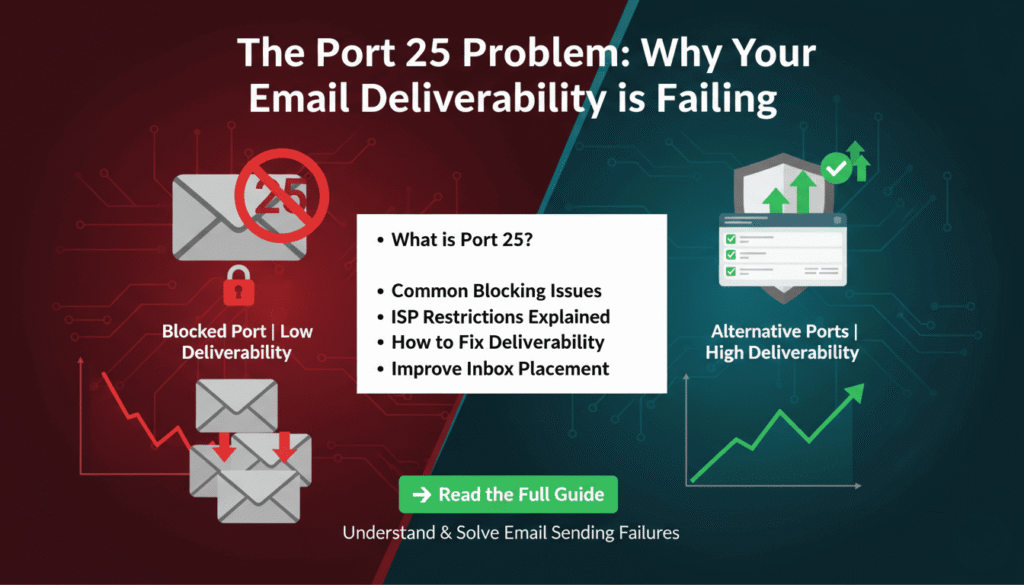
Email deliverability challenges have intensified significantly in 2025. While marketers focus on crafting compelling copy and irresistible offers, a technical infrastructure issue often undermines campaign success before messages even reach the inbox. Understanding the relationship between cloud-based email verification tools and SMTP port restrictions reveals why traditional accuracy standards no longer suffice.
Understanding the Email Deliverability Crisis
Modern email campaigns face an increasingly challenging delivery environment. Marketing teams invest substantial resources in message optimization, yet many campaigns experience unexpectedly low conversion rates. The root cause often lies not in messaging quality but in email list accuracy and sender reputation management.
Email service providers have implemented stricter filtering mechanisms in response to increasing spam volumes. When campaigns include invalid email addresses, bounce rates increase rapidly. These bounces trigger reputation penalties that affect delivery of subsequent messages, creating a cascading effect that damages overall campaign performance.
The relationship between bounce rates and sender reputation operates on a threshold basis. Once bounce rates exceed certain limits, email providers automatically reroute messages to spam folders or block delivery entirely. This makes proactive email list maintenance essential rather than optional for successful email marketing.
The Cloud Infrastructure Challenge
Major cloud computing providers including AWS, Google Cloud, and Microsoft Azure implement Port 25 restrictions as an anti-spam measure. Port 25 serves as the standard SMTP port for email transmission, and blocking it prevents compromised cloud instances from becoming spam sources. While this security measure benefits the broader internet ecosystem, it creates technical limitations for email verification systems.
Email verification requires establishing SMTP connections to target mail servers to confirm address validity. Traditional verification methods connect directly to mail servers on Port 25 and simulate the beginning of email delivery. This process, known as SMTP verification, provides the highest accuracy for determining whether specific email addresses exist and can receive messages.
Cloud-based verification services cannot perform direct Port 25 connections from standard cloud infrastructure. Instead, they must implement workarounds such as proxy server networks or rely on less accurate validation methods. These alternatives include DNS-only checks that verify domain existence without confirming individual mailbox validity, reducing overall verification accuracy.
“Organizations implementing high-volume email verification on cloud platforms face systematic accuracy limitations due to Port 25 restrictions. The infrastructure constraints make it impossible for cloud-based tools to perform traditional SMTP handshake verification.”
DNS Verification Limitations
DNS validation checks whether a domain has properly configured mail exchanger records. This verification layer confirms that the domain can theoretically receive email but provides no information about whether specific email addresses exist. A domain might have valid MX records while containing numerous invalid individual mailboxes.
Consider a scenario where a company domain has proper DNS configuration but individual employees have left the organization. DNS checks would validate all addresses at that domain as potentially deliverable, while SMTP verification would identify the non-existent mailboxes. This accuracy gap becomes significant when processing large email lists where even small error percentages represent thousands of invalid addresses.
The “Unlimited” Plans Problem
Many cloud-based email verification services advertise unlimited verification plans. However, the infrastructure costs of processing millions of verifications create economic pressure for providers to implement usage controls. These controls often manifest as throttling mechanisms that reduce verification speed as volume increases.
Throttling creates operational challenges for organizations processing large email lists. Verification tasks that should complete in hours may extend to days when throttling activates. The unpredictability of when throttling begins and its severity makes capacity planning difficult for marketing operations teams.
New Email Provider Requirements for 2025
Gmail and Yahoo implemented strict deliverability requirements in 2024 that fundamentally changed email verification standards. These providers now enforce a 0.3% spam complaint threshold and a 0.5% bounce rate limit. Exceeding these thresholds triggers immediate deliverability penalties that can persist for months.
Previous industry standards accepted bounce rates between 2% and 5% as normal. Under the new requirements, a 2% bounce rate would be four times higher than the maximum acceptable threshold. This dramatic shift means verification tools providing 97-98% accuracy no longer meet the necessary standards for maintaining good sender reputation.
| Metric | Previous Standard | 2025 Requirement |
|---|---|---|
| Maximum Bounce Rate | 2.0% – 5.0% | Below 0.5% |
| Required Verification Accuracy | 97% – 98% | 99.5%+ |
| Spam Complaint Limit | 0.5% – 1.0% | Below 0.3% |
| Reputation Repair Time | 2-4 weeks | 3-6 months |
The Mathematical Reality of Accuracy Requirements
A verification tool with 97% accuracy produces a 3% error rate. When applied to a list of 100,000 email addresses, this results in 3,000 invalid addresses. If these addresses are used in a campaign, the resulting 3% bounce rate is six times higher than the 0.5% threshold enforced by major email providers.
The consequences of exceeding bounce rate thresholds extend beyond a single campaign. Email providers implement sender reputation systems that track bounce patterns over time. A single high-bounce campaign can damage reputation scores sufficiently to affect deliverability for weeks or months, even for subsequent campaigns using perfectly clean lists.
Organizations that experience sender reputation damage face a lengthy recovery process. Repairing reputation typically requires 3-6 months of consistent low-bounce sending patterns. During this period, inbox placement rates remain suppressed, reducing campaign effectiveness and revenue generation. The cost of reputation damage far exceeds the investment in proper email verification infrastructure.
Specialized Verification Approaches
Email verification tools face a fundamental trade-off between breadth and depth. Services that attempt to verify addresses across all email providers must develop separate handling logic for each provider’s unique characteristics. This broad approach necessarily dilutes the accuracy achievable for any specific provider.
Gmail represents approximately 80% of consumer email addresses in B2C marketing contexts. This concentration means verification accuracy for Gmail addresses disproportionately affects overall campaign performance. Tools that specialize in Gmail verification can achieve higher accuracy by deeply understanding Gmail’s specific SMTP response codes and validation behaviors.
Comparative Accuracy Analysis
Verification accuracy differences compound significantly at scale. In controlled testing of 100,000 email addresses, general-purpose verification tools produced approximately 2,200 false negatives and false positives combined. Specialized verification systems using direct SMTP connections produced only 10 errors in the same test set.
This represents a 220-fold accuracy improvement. When applied to a 1 million address email list, the difference translates to 30,000 errors versus 100 errors. For organizations sending regular campaigns, this accuracy gap directly impacts bounce rates, sender reputation, and ultimately campaign ROI.
False negatives deserve particular attention because they represent lost business opportunities. When verification tools incorrectly classify valid addresses as invalid, organizations remove potential customers from their marketing reach. At typical e-commerce conversion rates, each false negative represents measurable lost revenue.
The Economics of Email Verification
Email verification services typically charge monthly subscription fees based on verification volume. Organizations processing millions of addresses annually may pay $3,000-$10,000 per year for verification services. These recurring costs compound over time while providing variable accuracy that may not meet 2025 deliverability requirements.
The subscription model creates an ongoing transfer of marketing budget to verification service providers. Over a five-year period, a typical mid-sized organization might spend $15,000-$50,000 on email verification. This expenditure represents opportunity cost that could instead fund customer acquisition or product development.
Hidden Costs of Inaccurate Verification
Beyond direct subscription costs, inaccurate verification imposes indirect financial penalties. False negatives remove valid email addresses from marketing lists, reducing the addressable audience for campaigns. For organizations with average order values of $50-$100, each false negative represents potential lost revenue.
A verification service producing 890 false negatives per 100,000 addresses would remove nearly 1% of a valid email list. For an organization with a 1 million address list and 2% campaign conversion rates, this translates to 8,900 lost potential conversions. At $75 average order value, this represents $667,500 in unrealized revenue over time.
“Email verification accuracy directly impacts revenue generation. Organizations must evaluate verification solutions not just on cost but on the financial impact of accuracy differences across large email lists.”
Return on Investment for Infrastructure Investment
Organizations can compare subscription-based verification costs against one-time infrastructure investments. A company spending $9,600 annually on verification services would spend $48,000 over five years. A one-time investment in verification infrastructure providing similar or better accuracy would achieve full return on investment within months.
The ROI calculation becomes more favorable when factoring in accuracy improvements. Higher verification accuracy reduces bounce rates, improving sender reputation and inbox placement. This creates a compounding benefit where better verification enables more effective campaigns that generate higher returns.
Data Privacy and Email List Security
Email lists represent valuable business assets containing customer contact information and behavioral data. Uploading these lists to third-party verification services creates security and privacy risks. The lists pass through external infrastructure where they might be logged, analyzed, or potentially compromised.
GDPR and similar data protection regulations impose strict requirements on how organizations process personal data. Transferring email addresses to third-party services requires appropriate data processing agreements and security guarantees. Local email verification eliminates these compliance complications by keeping data within organization-controlled infrastructure.
Compliance Benefits of Local Processing
Organizations operating in regulated industries face heightened data protection requirements. Healthcare, financial services, and government sectors often prohibit transferring personally identifiable information to external service providers without extensive security reviews. Local email verification provides a path to maintaining list quality while meeting regulatory requirements.
Data residency requirements in some jurisdictions mandate that personal information remain within specific geographic boundaries. Cloud-based verification services with distributed infrastructure may process data across multiple regions, creating compliance challenges. Local verification ensures complete control over data location and processing.
Building Verification Infrastructure
Organizations can implement email verification infrastructure using standard server environments. Unlike cloud platforms that block Port 25, dedicated servers and VPS hosting typically allow full SMTP connectivity. This enables direct implementation of SMTP verification protocols without the limitations affecting cloud-based services.
Modern email verification libraries exist for all major programming languages. Python, Node.js, PHP, and other environments provide well-maintained libraries that handle SMTP protocol details. These libraries enable developers to implement verification systems without deep protocol expertise.
Infrastructure Requirements
Effective email verification infrastructure requires proper network configuration. Servers need clean IP addresses with proper reverse DNS records to avoid being classified as spam sources by target mail servers. SPF and DKIM records should be configured to demonstrate legitimate email infrastructure.
Processing capacity needs scale with verification volume. A single server can typically verify 50,000-100,000 addresses per hour when properly configured. Organizations with larger lists may benefit from distributed verification systems that parallelize processing across multiple servers.
Rate limiting and throttling mechanisms protect against triggering anti-abuse systems on target mail servers. Verification systems should implement delays between connection attempts and respect temporary failure responses. This ensures sustainable verification operations that maintain good relationships with email providers.
Implementing Effective Verification Strategies
Email verification should operate as part of a comprehensive data quality program rather than a one-time cleanup effort. Organizations benefit from implementing verification at multiple points in the email lifecycle.
Real-time verification at the point of collection prevents invalid addresses from entering databases. When users submit email addresses through web forms or during registration, immediate verification can request correction of typos or invalid entries. This proactive approach maintains list quality at the source.
Ongoing List Maintenance
Email addresses decay over time as people change jobs, abandon accounts, or domains expire. Industry research suggests approximately 22-30% of email addresses become invalid each year. Regular verification of existing lists identifies newly invalid addresses before they impact campaign performance.
Engagement-based cleaning complements verification by identifying addresses that receive emails but never interact with them. Subscribers who haven’t opened emails in 6-12 months may have abandoned addresses or set up filters that prevent engagement. Removing or re-engaging these addresses improves overall list quality metrics.
Segmentation and Prioritization
Not all email addresses warrant the same verification effort. High-value customers or engaged subscribers deserve more frequent verification than cold prospects. Organizations can implement tiered verification strategies that apply different verification frequencies based on address value and engagement history.
Newly acquired addresses should undergo immediate comprehensive verification before being added to active sending lists. This prevents invalid addresses from affecting sender reputation during their first campaign appearance. Established addresses with positive engagement history can undergo less frequent verification checks.
Conclusion
Email deliverability in 2025 demands verification accuracy levels that cloud-based tools struggle to provide due to Port 25 restrictions and infrastructure limitations. The shift to 0.5% bounce rate thresholds by major email providers makes previous accuracy standards insufficient for protecting sender reputation.
Organizations face a strategic choice between continuing subscription-based verification with inherent limitations or investing in infrastructure that enables higher accuracy through direct SMTP verification. The financial and operational benefits of improved accuracy compound over time through better sender reputation, reduced false negatives, and lower ongoing costs.
Email verification represents a critical component of modern digital marketing infrastructure. As email provider requirements continue tightening, organizations that invest in high-accuracy verification gain competitive advantages through improved deliverability and campaign performance.
