
Cheap Email Verification: Why One-Time Payment Beats Monthly Subscriptions
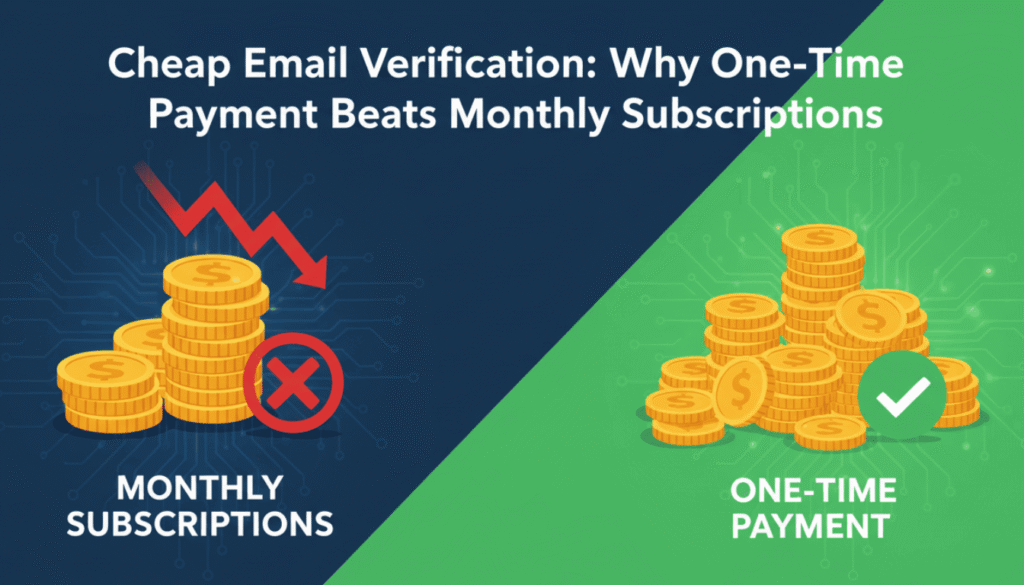
Businesses searching for cheap email verification often focus on low monthly rates. However, these affordable-looking subscriptions accumulate into massive long-term costs. For example, a $200 monthly subscription totals $12,000 over five years. Meanwhile, truly affordable email verification uses one-time payments that remain fixed forever.
This comprehensive analysis reveals the true economics of cheap email verification services. Moreover, we demonstrate how apparent savings actually cost more long-term. Furthermore, affordable email verification solutions exist that deliver superior accuracy while eliminating recurring expenses. As a result, smart businesses achieve better outcomes at dramatically lower total cost.
Our research compared pricing models across major verification platforms. Additionally, we calculated hidden costs that vendors rarely disclose upfront. The findings clearly show one-time payment models provide the most affordable email verification over any meaningful timeframe. Therefore, initial investment quickly becomes the cheapest option available.
The True Cost of Cheap Email Verification Services
Surface-level pricing comparison misleads businesses about actual verification costs. Moreover, vendors structure pricing to obscure long-term expenses. Understanding complete cost requires examining subscription mathematics, hidden fees, and expiration policies. Let us analyze each component systematically.
Monthly Subscription Math Over Time
Monthly subscriptions appear cheap initially but accumulate relentlessly. For instance, a $200 monthly plan seems reasonable compared to $597 upfront. However, simple multiplication reveals the truth. After just three months, monthly costs exceed one-time payments. Therefore, the break-even point occurs remarkably quickly.
Cost Reality Check:
- Month 1-3: $200 × 3 = $600 (slightly more than $597 one-time)
- Year 1: $200 × 12 = $2,400 (4x more expensive)
- Year 3: $200 × 36 = $7,200 (12x more expensive)
- Year 5: $200 × 60 = $12,000 (20x more expensive)
The mathematics become even more unfavorable as timeframes extend. Consider businesses operating for decades rather than years. A company using cheap email verification subscriptions for ten years spends $24,000. Meanwhile, one-time payment remains $597 regardless of duration. Therefore, subscription models exponentially increase costs over time.
Most businesses underestimate their verification longevity. For example, companies assume they might switch platforms within two years. However, verification becomes embedded in workflows and changing providers creates friction. Consequently, businesses typically maintain verification subscriptions much longer than initially planned. This behavior amplifies subscription cost disadvantages.
Hidden Fees Nobody Mentions Upfront
Published monthly rates rarely include all verification expenses. Many cheap email verification platforms charge additional fees for essential features. For instance, API access often requires premium tier upgrades costing $50-100 extra monthly. Similarly, bulk processing might incur surcharges beyond base subscription rates.
Setup fees catch new customers by surprise during onboarding. Enterprise accounts particularly face $500-1,000 setup charges that vendors omit from advertised pricing. Moreover, some platforms charge monthly minimums regardless of actual usage. Therefore, businesses pay for verification capacity they never utilize.
Integration costs add further hidden expenses. Connecting verification platforms with CRM systems or marketing automation requires technical implementation. This work consumes developer time valued at $100-200 hourly. Consequently, total implementation costs exceed subscription fees themselves during initial months.
Credit Expiration Policies Cost You Money
Many affordable email verification platforms implement credit expiration to maximize revenue. Specifically, unused credits vanish after 30-90 days depending on plan terms. Therefore, businesses face use-it-or-lose-it pressure encouraging wasteful verification. As a result, companies verify unnecessarily to avoid forfeiting purchased credits.
Seasonal businesses suffer particularly from expiration policies. For example, retail companies need heavy verification before holiday campaigns. However, they pay for credits year-round despite seasonal usage patterns. Moreover, unused summer credits expire before holiday season begins. Therefore, expiration policies force buying additional credits beyond actual requirements.
Credit banking restrictions prevent accumulating unused capacity. Some platforms limit rolling credits forward to just one billing cycle. Consequently, businesses cannot save credits during slow periods for future busy seasons. This artificial restriction optimizes vendor revenue while penalizing customer flexibility. Therefore, total costs exceed what usage-based pricing would suggest.
Affordable Email Verification: Comparing Payment Models
Direct comparison between payment models reveals dramatic cost differences. Moreover, analyzing specific timeframes shows when each model becomes advantageous. This cheap email verification analysis uses real pricing from major platforms for accuracy.
Monthly Subscription Pricing Breakdown
Monthly subscriptions typically range from $80 to $400 depending on verification volume. Budget platforms like EmailListVerify charge $80-150 monthly. Mid-tier services including Clearout cost $200-250 monthly. Premium platforms such as ZeroBounce charge $300-400 monthly. However, all accumulate into substantial long-term expenses.
| Platform Category | Monthly Cost | Year 1 Total | Year 3 Total | Year 5 Total |
|---|---|---|---|---|
| Budget Platforms | $100 | $1,200 | $3,600 | $6,000 |
| Mid-Tier Services | $200 | $2,400 | $7,200 | $12,000 |
| Premium Platforms | $350 | $4,200 | $12,600 | $21,000 |
These calculations assume constant pricing without increases. However, vendors typically raise prices annually by 3-8%. Therefore, actual five-year costs exceed projections based on current rates. For instance, a platform starting at $200 monthly might cost $240 monthly by year five. Consequently, total expenses grow faster than simple multiplication suggests.
One-Time Payment Total Cost
One-time payment models charge single upfront fees for lifetime access. Bounce Checker pioneered this approach with $597 total cost. This payment covers unlimited verifications permanently without recurring charges. Moreover, updates and support continue indefinitely at no additional expense. Therefore, total cost remains fixed regardless of usage or timeframe.
The one-time model eliminates budget uncertainty completely. Finance teams can treat verification as capital expense rather than ongoing operational cost. Furthermore, unlimited usage removes anxiety about credit consumption. As a result, businesses verify as frequently as needed for optimal list hygiene without financial pressure.
Five-Year Cost Comparison Analysis
Five-year timeframes provide realistic comparison windows for technology investments. Most businesses maintain verification solutions for at least five years once implemented. Therefore, this duration reveals true cost differences between models. The analysis shows one-time payment delivers cheapest option consistently.
| Payment Model | Upfront Cost | Year 1 Total | Year 3 Total | Year 5 Total | Savings vs Monthly |
|---|---|---|---|---|---|
| One-Time Payment | $597 | $597 | $597 | $597 | $11,403 |
| Monthly ($200) | $200 | $2,400 | $7,200 | $12,000 | Reference |
| Monthly ($350) | $350 | $4,200 | $12,600 | $21,000 | -$8,400 |
Break-even analysis shows one-time payment recovers investment within three months. Specifically, $200 monthly subscription costs $600 over three months. Meanwhile, one-time payment costs $597 total. Therefore, every month after month three represents pure savings compared to subscription models.
Ten-year projections amplify savings even further. Monthly subscriptions at $200 cost $24,000 over ten years. However, one-time payment remains $597 regardless of duration. Consequently, ten-year savings reach $23,403 for choosing truly affordable email verification through one-time payment.
When Cheap Actually Costs More
Low prices often indicate poor accuracy rather than genuine value. Moreover, verification errors create costs that dwarf subscription savings. Understanding these hidden expenses reveals why cheap email verification sometimes represents the most expensive choice. Let us examine three critical cost factors.
Low Accuracy Equals Lost Revenue
Verification accuracy directly impacts campaign revenue through deliverability and sender reputation. For example, a platform with 95% accuracy produces 5,000 errors per 100,000 addresses. These errors cause bounces that damage sender reputation. Consequently, future campaigns suffer reduced inbox placement even for valid addresses.
Revenue loss from poor deliverability exceeds verification cost savings significantly. Consider a company sending campaigns worth $50,000 monthly in sales. A 10% deliverability decrease costs $5,000 monthly in lost revenue. Therefore, choosing verification that saves $100 monthly but costs $5,000 in lost sales represents catastrophic decision-making.
Budget verification platforms typically achieve 94-96% accuracy compared to 99.99% for specialized tools. This 4-6% accuracy gap translates to 4,000-6,000 additional errors per 100,000 verifications. Moreover, these errors accumulate over multiple campaigns. As a result, sender reputation degradation compounds over time rather than remaining constant.
False Positives Remove Valid Subscribers
False positives represent valid addresses incorrectly marked as invalid. These errors cause businesses to remove good subscribers unnecessarily. For instance, a verification platform with 2% false positive rate removes 2,000 valid subscribers per 100,000 verifications. Therefore, cheap email verification that produces false positives shrinks your revenue-generating audience.
Subscriber acquisition costs make false positives particularly expensive. Businesses typically spend $10-50 acquiring each email subscriber through advertising and content marketing. Therefore, removing 2,000 valid subscribers wastes $20,000-100,000 in acquisition investment. Consequently, verification saving $1,000 annually while removing $50,000 worth of subscribers clearly costs more than it saves.
List growth suffers when verification consistently removes valid addresses. For example, adding 5,000 new subscribers monthly while removing 2,000 valid ones yields only 3,000 net growth. Meanwhile, proper verification would maintain all 5,000 additions. Therefore, false positives slow business growth beyond immediate revenue impact.
Poor Verification Damages Sender Reputation
Email providers track sender reputation through bounce rates and engagement metrics. High bounce rates signal poor list hygiene and reduce sender reputation scores. For instance, consistently bouncing 3-5% indicates problems to Gmail and Outlook. Consequently, these providers downgrade your sender reputation and route messages to spam folders.
Sender reputation damage persists long after fixing verification problems. Once labeled as low-quality sender, rebuilding reputation takes 3-6 months of perfect behavior. During this period, campaigns suffer reduced deliverability despite proper list hygiene. Therefore, cheap email verification creating reputation damage costs months of reduced campaign performance.
Shared IP addresses amplify reputation damage across entire organizations. Many businesses send email through shared marketing platforms. Poor sender reputation from one department affects all users on the same IP. Therefore, cheap verification that damages reputation potentially harms your entire company’s email infrastructure.
Cheap Email Verification Without Compromising Quality
Truly affordable email verification combines low total cost with high accuracy. This optimal combination exists through strategic business models and technical specialization. Moreover, understanding how platforms achieve both helps identify genuine value. Let us examine the approach that delivers quality and affordability simultaneously.
How Bounce Checker Delivers Both
Bounce Checker achieves 99.99% accuracy while costing less long-term than budget competitors. The platform accomplishes this through one-time payment model and Gmail specialization. Specifically, eliminating recurring billing infrastructure reduces operational costs. Meanwhile, focusing exclusively on Gmail enables deeper technical optimization.
Traditional subscription models require substantial infrastructure for billing, collections, and account management. For instance, platforms need payment processing systems, subscription management software, and collections departments. These operational expenses typically consume 20-30% of revenue. Therefore, eliminating subscription infrastructure enables lower pricing despite superior technology.
Cost Structure Comparison:
- Subscription platforms: 30% billing infrastructure + 40% technology + 30% marketing
- One-time payment: 70% technology + 30% marketing (no billing overhead)
- Result: More resources dedicated to verification accuracy rather than billing systems
Customer success teams required for subscription retention create additional costs. Subscription platforms must constantly prevent churn through account management and support. However, one-time payment platforms need only initial onboarding support. Therefore, operational efficiency enables both better technology and lower pricing simultaneously.
Gmail Specialization Reduces Infrastructure Costs
General-purpose verification requires infrastructure supporting all email providers. For example, platforms must maintain validation systems for Gmail, Yahoo, Outlook, and hundreds of smaller providers. This breadth demands significant technical resources. Moreover, each provider requires separate validation logic and ongoing maintenance.
Specializing in Gmail eliminates 80% of infrastructure complexity. Bounce Checker focuses exclusively on Gmail which represents 75-85% of business email lists. Therefore, technical resources concentrate on one platform rather than spreading across many. As a result, Gmail accuracy reaches 99.99% while infrastructure costs decrease.
Development efficiency improves when focusing on single platform. Engineers become experts in Gmail-specific validation rather than generalists across many providers. Furthermore, updates happen faster since changes affect only one system. Consequently, specialization enables both better accuracy and lower operational costs creating genuinely affordable email verification.
One-Time Payment Eliminates Recurring Expenses
The one-time payment model fundamentally changes verification economics. Businesses pay $597 once and receive unlimited verifications permanently. This structure eliminates all future expenses regardless of usage volume or timeframe. Moreover, companies can budget verification as capital expense rather than ongoing operational cost.
Unlimited verification removes financial barriers to aggressive list hygiene. For instance, businesses can verify their entire database quarterly without worrying about costs. Similarly, verifying before every campaign costs nothing additional. Therefore, optimal verification frequency becomes operationally driven rather than financially constrained.
ROI Calculator: Your Real Verification Costs
Understanding your specific verification costs requires calculating actual expenses. Moreover, projecting these costs over realistic timeframes reveals true financial impact. This section provides frameworks for analyzing your verification ROI accurately. Therefore, businesses can make informed decisions based on their specific situations.
Calculating Your Current Annual Spend
Most businesses underestimate their total verification expenses. Monthly subscription costs represent obvious expenses but hidden costs accumulate silently. Therefore, comprehensive calculation includes subscriptions, setup fees, overage charges, and integration costs. Add these components to determine true annual verification spend.
Start by identifying your base monthly subscription rate. For example, $200 monthly totals $2,400 annually. Subsequently, add any annual fees or setup charges paid during implementation. Similarly, include overage charges when verification volume exceeds plan limits. Finally, calculate developer time spent on integration and maintenance at $150 hourly.
| Cost Component | Example Monthly | Annual Total |
|---|---|---|
| Base Subscription | $200 | $2,400 |
| Overage Charges | $30 | $360 |
| API Premium Tier | $50 | $600 |
| Support/Maintenance | $20 | $240 |
| Total Annual Cost | $300 | $3,600 |
This comprehensive view often reveals annual costs exceeding initial estimates by 20-50%. Moreover, costs typically increase over time through price raises and volume growth. Therefore, current annual spend provides baseline for projecting future expenses.
Projecting Five-Year Subscription Costs
Five-year projections reveal subscription model’s true financial impact. Begin with current annual cost as baseline. Subsequently, apply 5% annual price increases that most vendors implement. Additionally, account for 10-15% annual volume growth as your business scales. Therefore, year five costs substantially exceed year one expenses.
Conservative projection assumes constant usage without price increases. For example, $3,600 annual cost multiplied by five years equals $18,000 total. However, realistic projection includes growth and inflation. Therefore, actual five-year costs typically reach $20,000-25,000 for initially $3,600 annual spending.
Five-Year Projection Example:
- Year 1: $3,600 (baseline)
- Year 2: $3,780 (5% increase)
- Year 3: $3,969 (5% increase + volume growth)
- Year 4: $4,368 (compound effects)
- Year 5: $4,805 (continued growth)
- Total: $20,522
Comparing Against One-Time Alternatives
One-time payment comparison shows dramatic savings potential. Subtract $597 from five-year subscription projection to calculate total savings. For example, $20,522 subscription cost minus $597 one-time payment equals $19,925 savings. Therefore, choosing affordable email verification through payment model saves nearly $20,000.
Savings calculations become even more favorable over longer timeframes. Ten-year projections show subscription costs continuing to accumulate. Meanwhile, one-time payment remains $597 regardless of duration. Consequently, ten-year savings often exceed $40,000 for businesses currently spending $300 monthly on verification.
Return on investment calculation shows payback period. Specifically, $597 investment divided by $300 monthly subscription savings equals 2.0 months. Therefore, one-time payment recovers investment in just two months. Every subsequent month represents pure profit compared to subscription alternative.
(Internal link suggestion: Use our interactive ROI calculator to see your specific verification savings)
Budget-Friendly Strategies for Email Verification
Optimization strategies reduce verification costs regardless of platform choice. Moreover, smart verification practices improve results while lowering expenses. These approaches help businesses maximize value from their cheap email verification investments. Therefore, combining smart strategy with affordable platforms delivers optimal outcomes.
Verify Strategically Not Constantly
Verification frequency should match list dynamics rather than arbitrary schedules. For instance, static lists with minimal additions need only quarterly verification. Meanwhile, rapidly growing lists benefit from monthly verification. Therefore, matching frequency to actual need prevents wasteful verification spending.
Focus verification efforts on high-risk segments. New subscribers require immediate verification since they might contain typos or fake addresses. However, engaged subscribers who consistently open emails need less frequent verification. As a result, risk-based verification reduces total volume while maintaining list quality.
Campaign-triggered verification ensures lists stay fresh without constant checking. Verify your database 1-2 days before launching major campaigns. This timing catches recently invalid addresses while avoiding wasteful interim verification. Moreover, campaign timing naturally creates verification schedule aligned with actual email sending.
Focus on High-Value List Segments
Not all email addresses deserve equal verification investment. For example, subscribers who purchased recently generate more revenue than dormant contacts. Therefore, prioritize verification resources on high-value segments. This approach maximizes ROI from limited verification budgets.
Segment your list by engagement and value metrics. Create tiers such as highly engaged, moderately engaged, and inactive subscribers. Subsequently, verify high-value tiers monthly while checking lower tiers quarterly. As a result, verification spending aligns with subscriber value rather than treating all addresses equally.
Consider abandoning very low-value segments entirely. Subscribers inactive for 18+ months rarely re-engage regardless of verification. Therefore, removing these addresses eliminates verification costs without harming results. Moreover, smaller lists reduce ongoing email platform costs beyond just verification savings.
Automate Verification Workflows
Automation reduces manual effort while ensuring consistent verification. For instance, automatically verify new subscribers within 24 hours of signup. Similarly, schedule quarterly verification for entire database through automated processes. Therefore, verification happens reliably without consuming team time.
API integration enables real-time verification during signup processes. Users receive immediate feedback about email validity before completing registration. This approach prevents invalid addresses from entering your database initially. Moreover, frontend validation costs less than batch verification since it processes only new additions.
Trigger-based verification responds to specific events automatically. For example, verify addresses returning soft bounces during campaigns. Similarly, check addresses after failed delivery attempts. These targeted verifications focus resources where they matter most rather than blanket checking entire lists unnecessarily.
Making the Switch to Affordable Email Verification
Transitioning from subscription to one-time payment delivers immediate and long-term benefits. Moreover, the migration process requires minimal effort and disruption. Understanding the transition steps helps businesses move confidently toward truly cheap email verification. Let us examine the complete process.
Calculating Your Break-Even Point
Break-even analysis shows exactly when one-time payment becomes cheaper than subscriptions. Divide $597 by your monthly subscription cost to calculate months until break-even. For example, $597 divided by $200 monthly equals 2.99 months. Therefore, one-time payment becomes cheaper starting month three.
Most businesses reach break-even within 2-4 months depending on current subscription rates. This rapid payback means minimal financial risk. Moreover, every month beyond break-even represents pure savings. Consequently, five-year savings reach $11,000+ for typical verification spending.
| Current Monthly Cost | Break-Even (Months) | Year 1 Savings | 5-Year Savings |
|---|---|---|---|
| $100 | 6.0 | $603 | $5,403 |
| $200 | 3.0 | $1,803 | $11,403 |
| $300 | 2.0 | $3,003 | $17,403 |
| $400 | 1.5 | $4,203 | $23,403 |
Return on investment calculation confirms financial wisdom of switching. Even businesses paying only $100 monthly save $5,403 over five years. Meanwhile, those paying $400 monthly save $23,403 during the same period. Therefore, switching delivers substantial financial benefits regardless of current spending level.
Migration Process Step by Step
Switching verification platforms requires three simple steps completed in approximately 30 minutes. First, export your verification history from current platform for records. Second, create your new account and complete one-time payment. Third, upload your email list and run initial verification. Therefore, migration completes quickly without operational disruption.
Export all data from current platform before canceling subscription. Most platforms allow CSV download of verification history and results. Save these files as backup even though you will re-verify addresses. Moreover, check your current platform’s cancellation policy to avoid unnecessary charges.
Set up new account by visiting Bounce Checker and completing registration. The process requires basic information and takes approximately 5 minutes. Subsequently, complete the $597 one-time payment using credit card or PayPal. Your account activates immediately after payment confirmation. Therefore, you can begin verifying within minutes of signing up.
Upload your email list through the bulk verification interface. The system accepts CSV and TXT files with automatic email detection. Processing typically completes within 30-60 minutes depending on list size. Download verified results and import clean addresses into your email platform. As a result, you have fresh verification results from your new affordable email verification solution.
Immediate and Long-Term Savings
Immediate savings begin the moment you cancel previous subscription. For example, businesses paying $200 monthly save this amount starting next billing cycle. Therefore, monthly subscription elimination provides instant cash flow improvement. Moreover, this savings recurs automatically every month thereafter.
First-year savings equal annual subscription cost minus $597 one-time payment. For instance, $200 monthly subscription costs $2,400 annually. Subtracting $597 leaves $1,803 first-year savings. Therefore, switching delivers immediate financial benefit even accounting for one-time payment.
Budget reallocation opportunities emerge from verification savings. The $2,400 annual savings can fund approximately 48 additional email campaigns at $50 per campaign. Alternatively, invest savings in list growth through content marketing or paid advertising. Therefore, choosing cheap email verification frees budget for revenue-generating activities rather than ongoing verification expenses.
(Internal link suggestion: Read our complete guide to switching email verification platforms without disruption)
Stop Paying Monthly – Start Saving Permanently
Why spend $12,000 over five years when $597 delivers better Gmail accuracy permanently? Calculate your specific savings with one-time payment verification. Break even in 2-3 months, then save thousands annually.
Get truly affordable email verification with 99.99% accuracy today.
Frequently Asked Questions About Cheap Email Verification
What is the cheapest email verification service?
Bounce Checker represents the cheapest email verification over any meaningful timeframe at $597 one-time payment. While some platforms advertise lower monthly rates like $80-100, these accumulate to $4,800-6,000 over five years. Therefore, one-time payment becomes cheapest option within 3 months and saves $5,000-11,000+ over five years. Moreover, Bounce Checker delivers 99.99% Gmail accuracy compared to 94-96% for budget subscription platforms.
Is cheap email verification accurate enough for business use?
Cheap email verification varies dramatically in accuracy depending on the platform. Budget subscription services typically achieve 94-96% accuracy producing 4,000-6,000 errors per 100,000 verifications. However, Bounce Checker achieves 99.99% accuracy despite lower total cost through one-time payment model. Therefore, genuinely affordable email verification need not sacrifice quality. The key is evaluating total cost over time rather than just monthly rates.
How much should I budget for email verification annually?
Email verification budget depends on payment model choice. Subscription platforms require $1,200-4,800 annually plus ongoing increases. However, one-time payment models like Bounce Checker cost $597 total with zero recurring expenses. Therefore, first-year budget of $597 covers verification permanently. This approach eliminates annual verification expenses entirely after initial year.
Do free email verification tools work well enough?
Free email verification tools typically achieve 85-90% accuracy compared to 95-99% for paid platforms. This 10-15% accuracy gap creates 10,000-15,000 errors per 100,000 verifications. Moreover, free tools impose severe volume limits preventing comprehensive list cleaning. Therefore, free verification costs more through poor deliverability than paid tools charge directly. Businesses should invest in affordable paid verification rather than accepting free tool limitations.
When is monthly subscription better than one-time payment?
Monthly subscriptions rarely provide better value than one-time payment for verification. However, businesses planning to verify for less than 3 months might prefer monthly flexibility. Additionally, organizations requiring multi-provider verification beyond Gmail might need subscription platforms. Nevertheless, most businesses verify email for years making one-time payment substantially cheaper. Therefore, monthly subscriptions suit only very short-term or specialized needs.
How do I calculate ROI from switching verification platforms?
Calculate ROI by comparing five-year costs between platforms. Multiply current monthly subscription by 60 months for five-year total. Subsequently, subtract $597 one-time payment to determine savings. For example, $200 monthly costs $12,000 over five years. Therefore, switching saves $11,403 while improving Gmail accuracy. Additionally, divide savings by $597 to calculate ROI percentage: $11,403 ÷ $597 = 1,910% five-year ROI.
Can I negotiate better pricing with subscription platforms?
Some subscription platforms offer discounts for annual prepayment or high volumes. However, even 20-30% discounts rarely match one-time payment economics. For instance, $200 monthly with 25% discount costs $1,800 annually or $9,000 over five years. This still exceeds $597 one-time payment by $8,403. Therefore, negotiated subscription discounts cannot overcome fundamental cost structure disadvantage. One-time payment remains substantially cheaper regardless of subscription discounts.
What happens if I cancel my subscription platform mid-year?
Most subscription platforms allow cancellation anytime but no refunds for unused months. Annual prepaid plans typically prohibit refunds even with early cancellation. Therefore, switching platforms mid-year means forfeiting remaining subscription value. However, quick break-even period for one-time payment means switching still saves money within 2-3 months. Consequently, immediate switching typically outweighs finishing current subscription period.
