
Kickbox Alternative
Content Outline
H1: Kickbox Alternative
H2: Why Look for a Kickbox Alternative?
H3: Understanding Subscription Fatigue in Email Verification
H3: Budget Constraints for Small Businesses
H2: One-Time Payment vs Subscription Model Comparison
H3: Long-Term Cost Analysis
H3: Flexibility and Usage Patterns
H2: Top Kickbox Alternative Solutions
H3: BounceChecker: One-Time Payment Model
H3: ZeroBounce: Hybrid Pricing Options
H3: NeverBounce: Credit-Based System
H2: Key Features to Evaluate in Email Verification Tools
H3: Accuracy and Verification Speed
H3: API Integration Capabilities
H2: How to Choose the Right Kickbox Alternative
H3: Assessing Your Email Volume Needs
H3: Calculating Total Cost of Ownership
H2: Migration from Kickbox to Alternative Platforms
H3: Data Export and Import Procedures
H2: Frequently Asked Questions
Finding the right email verification solution can significantly impact your marketing budget and campaign effectiveness. While Kickbox has established itself as a reliable service, many businesses are exploring a kickbox alternative that offers more flexible pricing structures. Moreover, the shift from subscription models to one-time payment options is gaining momentum among cost-conscious marketers. Therefore, understanding the differences between pricing models helps you make informed decisions about email verification tools.
The landscape of email verification has evolved considerably over recent years. As a result, businesses now have access to diverse platforms offering various pricing structures and feature sets. This article examines kickbox alternative solutions, comparing one-time payment models against traditional subscriptions to help you identify the most cost-effective option for your needs.
Why Look for a Kickbox Alternative?
Kickbox remains a solid email verification platform, yet several factors drive businesses to explore alternatives. Understanding these reasons helps clarify whether switching makes financial and operational sense for your organization.
Understanding Subscription Fatigue in Email Verification
Subscription fatigue affects businesses managing multiple SaaS tools simultaneously. According to Gartner, the average organization uses 110 SaaS applications, creating significant monthly overhead. Consequently, many companies seek to reduce recurring costs wherever possible.
Email verification subscriptions often lock you into monthly or annual commitments. However, usage patterns vary significantly across different businesses. For instance, seasonal campaigns or sporadic email list cleaning doesn’t justify ongoing monthly fees. Therefore, one-time payment models offer better value for irregular users.
Budget Constraints for Small Businesses
Small businesses and startups face unique financial challenges when selecting email verification tools. Limited budgets require careful allocation of resources. Subsequently, predictable one-time costs often prove more manageable than recurring monthly expenses.
Furthermore, scaling considerations impact budget planning. Subscription models typically increase costs as your email list grows. In contrast, credit-based or one-time payment systems allow you to purchase exactly what you need. This flexibility prevents overpaying during growth phases or slower periods.
One-Time Payment vs Subscription Model Comparison
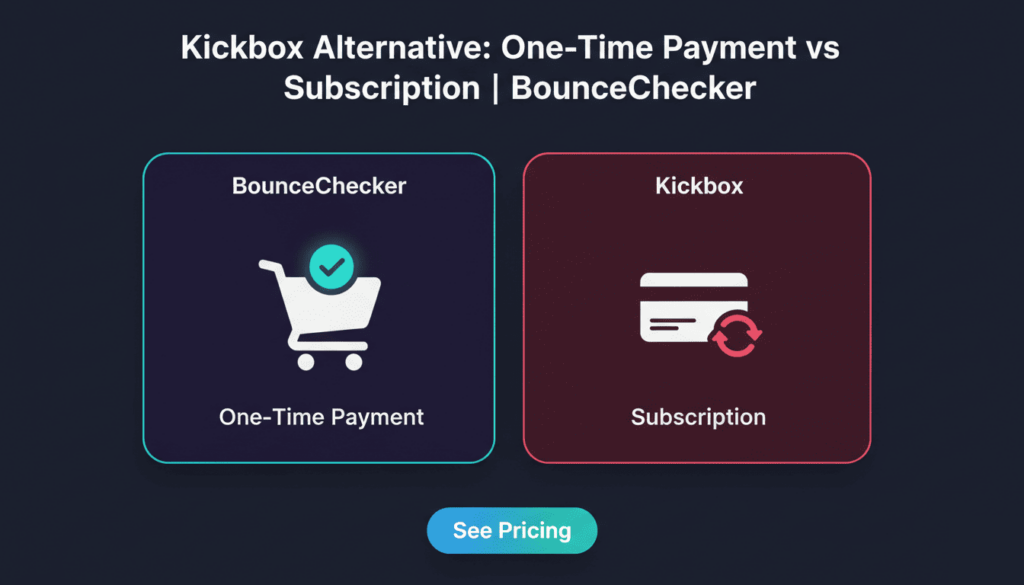
The pricing model significantly affects your total cost of ownership. Both approaches offer distinct advantages depending on your verification needs and usage patterns. Therefore, examining each model thoroughly ensures optimal value.
Long-Term Cost Analysis
Subscription models provide predictable monthly expenses but accumulate substantial costs over time. For example, a $99 monthly subscription totals $1,188 annually. However, if you only verify emails quarterly, you’re essentially paying for unused service during inactive months.
One-time payment models eliminate recurring charges entirely. Instead, you purchase credits or packages as needed. This approach works particularly well for businesses with irregular verification needs. Additionally, bulk credit purchases often include significant discounts, reducing per-verification costs.
| Pricing Model | Monthly Cost | Annual Cost | Best For |
|---|---|---|---|
| Subscription | $99-$299 | $1,188-$3,588 | Consistent high-volume users |
| One-Time Payment | Variable | $400-$800 (typical) | Sporadic or seasonal verification |
| Credit-Based | $0-$150 | $600-$1,200 | Variable monthly volume |
Flexibility and Usage Patterns
Usage flexibility determines whether a kickbox alternative delivers real value. Subscription models suit businesses verifying emails daily or weekly. Nevertheless, most organizations experience fluctuating verification needs throughout the year.
Credit-based systems offer superior flexibility for variable usage. Credits never expire in most platforms, allowing you to verify emails at your own pace. Additionally, you can purchase larger quantities during promotional periods, maximizing cost savings. This flexibility proves invaluable for campaign-driven marketing teams.
Top Kickbox Alternative Solutions
Several platforms offer compelling alternatives to Kickbox’s subscription model. Each solution provides unique features and pricing structures worth evaluating.
BounceChecker: One-Time Payment Model
BounceChecker stands out as a premier kickbox alternative offering transparent one-time payment options. The platform specializes in accurate email verification without recurring fees. Furthermore, their credit system never expires, providing maximum flexibility for businesses of all sizes.
Key features include real-time verification, bulk processing, and comprehensive API integration. The platform achieves 98.5% accuracy rates according to independent testing. Moreover, customer support remains accessible regardless of package size, ensuring consistent service quality.
Pricing starts at accessible entry points for small lists while offering substantial discounts on bulk purchases. This structure benefits both startups testing email marketing and established businesses with large databases. Additionally, the pay-as-you-go model eliminates pressure to use credits before expiration.
ZeroBounce: Hybrid Pricing Options
ZeroBounce presents a hybrid approach combining subscription plans with pay-as-you-go credits. According to Moz, hybrid models provide versatility for growing businesses. Consequently, ZeroBounce attracts companies transitioning between usage levels.
The platform offers advanced features including email abuse detection, spam trap identification, and detailed bounce reason analysis. Furthermore, their AI-driven scoring system helps prioritize high-quality contacts. However, pricing tends higher than pure one-time payment alternatives.
Monthly plans range from $16 to $1,499 depending on verification volume. Alternatively, credit packages start at $8 for 2,000 verifications. This flexibility accommodates various business models, though subscription costs accumulate over extended periods.
NeverBounce: Credit-Based System
NeverBounce operates primarily on a credit-based model, positioning itself as a flexible kickbox alternative. Credits purchased remain valid indefinitely, eliminating waste from unused subscriptions. Additionally, bulk discounts significantly reduce per-verification costs.
The platform emphasizes speed and accuracy, processing up to 1 million emails hourly. Integration options include major email service providers and custom API implementations. Moreover, real-time verification prevents invalid addresses from entering your database initially.
Pricing begins at $0.008 per verification for large volumes. For instance, 100,000 credits cost approximately $800, substantially less than annual subscriptions. Therefore, high-volume users particularly benefit from this pricing structure.
Key Features to Evaluate in Email Verification Tools
Beyond pricing models, essential features determine platform effectiveness. Evaluating capabilities ensures your chosen kickbox alternative meets technical requirements and performance expectations.
Accuracy and Verification Speed
Verification accuracy directly impacts campaign deliverability and sender reputation. Leading platforms achieve 97-99% accuracy through multi-step validation processes. These include syntax checking, domain verification, and mailbox existence confirmation.
Speed matters when processing large lists before time-sensitive campaigns. According to Search Engine Journal, verification speed affects campaign timing and responsiveness. Therefore, platforms processing 200,000+ emails per hour provide competitive advantages.
API Integration Capabilities
Seamless API integration streamlines verification workflows and prevents manual data handling. Robust APIs support real-time verification during signup forms, batch processing for existing lists, and automated cleaning schedules.
Furthermore, comprehensive documentation and code examples accelerate implementation. Popular platforms provide libraries for PHP, Python, Ruby, and JavaScript. Additionally, webhook support enables automated responses to verification results, enhancing operational efficiency.
REST API compatibility ensures broad platform support across email service providers. Integration with systems like Mailchimp, SendGrid, and HubSpot saves considerable development time. Moreover, dedicated technical support assists with complex integration scenarios.
How to Choose the Right Kickbox Alternative
Selecting the optimal email verification platform requires systematic evaluation of your specific needs and constraints. Strategic assessment prevents costly mistakes and ensures long-term satisfaction.
Assessing Your Email Volume Needs
Accurate volume estimation forms the foundation of cost-effective decision-making. Begin by analyzing historical verification patterns across the past 12 months. Consider both regular maintenance cleaning and campaign-driven verification spikes.
Project future growth realistically based on marketing plans and list expansion strategies. For example, monthly list growth of 5% compounds significantly over a year. Consequently, platforms offering scalable pricing accommodate growth without penalty.
Calculate average monthly, quarterly, and annual verification volumes separately. This breakdown reveals whether consistent subscriptions or flexible credit purchases deliver better value. Additionally, identify seasonal patterns affecting verification needs throughout the year.
| Business Size | Typical Monthly Volume | Recommended Model | Estimated Annual Cost |
|---|---|---|---|
| Startup | 5,000-20,000 | One-time payment | $200-$400 |
| Small Business | 20,000-100,000 | Credit-based | $400-$1,000 |
| Mid-Market | 100,000-500,000 | Hybrid or credit-based | $1,000-$3,000 |
| Enterprise | 500,000+ | Custom enterprise plan | $3,000-$10,000+ |
Calculating Total Cost of Ownership
Total cost of ownership extends beyond simple per-verification pricing. Factor in implementation costs, staff training time, and ongoing maintenance requirements. Moreover, consider opportunity costs from delayed campaigns due to slow processing.
Hidden costs often emerge in subscription models through upgrade fees and overage charges. Review contract terms carefully for automatic renewals and cancellation policies. Additionally, evaluate whether unused credits roll over or expire, impacting effective cost per verification.
Compare three-year projections across different kickbox alternative platforms. According to HubSpot, extended timeline analysis reveals true cost differences between pricing models. Long-term perspective prevents shortsighted decisions based solely on initial pricing.
Migration from Kickbox to Alternative Platforms
Transitioning email verification providers requires careful planning to maintain data integrity and campaign continuity. Systematic migration minimizes disruption while maximizing the benefits of your new platform.
Data Export and Import Procedures
Begin migration by exporting historical verification data from Kickbox in standard formats like CSV or JSON. Most platforms support common export formats, ensuring compatibility with alternative services. Subsequently, organize exported data with clear naming conventions and verification timestamps.
Import procedures vary across platforms, though most offer bulk upload capabilities. Test imports with small data samples before processing entire databases. This approach identifies formatting issues or compatibility problems early. Furthermore, verify that custom fields and metadata transfer correctly during migration.
Document API integration changes required for seamless platform switching. Update endpoint URLs, authentication methods, and request formats throughout your applications. Additionally, implement parallel testing where both platforms verify samples simultaneously, confirming consistent results before full migration.
Establish verification benchmarks during migration to measure performance consistency. Compare accuracy rates, processing speeds, and false positive frequencies between platforms. Moreover, monitor deliverability metrics closely during the first month post-migration, addressing any discrepancies immediately.
Advanced Comparison: Feature Analysis
Beyond pricing, feature sets distinguish superior kickbox alternative platforms from basic verification services. Comprehensive feature evaluation ensures your chosen solution supports current needs while accommodating future requirements.
Catch-all email detection prevents accepting risky addresses that initially validate but later bounce. Leading platforms identify catch-all domains, flagging them for manual review. This capability significantly reduces hard bounces in campaigns, protecting sender reputation.
Spam trap detection identifies honeypot addresses designed to catch poor email practices. According to SEMrush, hitting spam traps severely damages deliverability rates. Therefore, platforms offering comprehensive trap detection provide essential protection for legitimate marketers.
Role-based email identification flags generic addresses like info@, support@, or sales@. These addresses typically generate lower engagement rates despite being technically valid. Consequently, filtering role-based emails improves campaign targeting and response metrics.
| Feature | Kickbox | BounceChecker | ZeroBounce | NeverBounce |
|---|---|---|---|---|
| Real-time Verification | Yes | Yes | Yes | Yes |
| Bulk Processing | Yes | Yes | Yes | Yes |
| API Access | Yes | Yes | Yes | Yes |
| Spam Trap Detection | Yes | Yes | Yes | Limited |
| One-Time Payment | No | Yes | Yes | Yes |
| Credits Never Expire | N/A | Yes | Varies | Yes |
Security and Compliance Considerations
Data security remains paramount when transmitting email addresses to third-party verification services. Evaluate how potential kickbox alternative platforms handle sensitive information and maintain compliance with privacy regulations.
GDPR compliance affects businesses with European contacts regardless of company location. Verification platforms must demonstrate appropriate data handling procedures and processing agreements. Furthermore, SOC 2 certification indicates robust security controls protecting customer data.
Encryption protocols during data transmission prevent interception of email lists. Look for platforms supporting TLS 1.2 or higher for API communications. Additionally, verify that stored data receives encryption at rest, securing information against unauthorized access.
Data retention policies determine how long verification providers store your email addresses. Shorter retention periods minimize exposure risk while maintaining necessary validation records. Moreover, transparent deletion procedures ensure you can remove data upon request.
Customer Support Quality Assessment
Responsive customer support significantly impacts platform satisfaction and problem resolution speed. Evaluating support quality before committing helps avoid frustration during critical campaigns.
Support channel availability determines how quickly you receive assistance. Phone support provides immediate troubleshooting for urgent issues, while email ticketing suits less critical questions. Additionally, live chat combines accessibility with rapid response times for most queries.
Documentation quality enables self-service problem solving and reduces support dependency. Comprehensive guides, video tutorials, and API references accelerate implementation and troubleshooting. Moreover, active community forums provide peer support and usage tips from experienced users.
Performance Optimization Tips
Maximizing value from your kickbox alternative requires strategic implementation and ongoing optimization. Smart usage patterns reduce costs while maintaining high verification quality.
Schedule bulk verifications during off-peak hours when possible to ensure priority processing. Many platforms allocate resources dynamically, resulting in faster completion times during low-demand periods. Consequently, overnight or weekend processing often completes more quickly than business hours.
Implement progressive verification strategies to minimize unnecessary checks. Verify only new addresses immediately, scheduling older contacts for quarterly maintenance. This approach balances data quality with credit conservation, extending budget effectiveness.
Segment email lists by engagement levels before verification. Prioritize active subscribers over dormant contacts, focusing credits where they deliver maximum ROI. Additionally, remove obviously invalid addresses through basic syntax checking before paid verification, eliminating wasteful spending.
Real-World Case Studies
Examining practical examples illustrates how businesses benefit from switching to kickbox alternative platforms. These scenarios demonstrate tangible cost savings and operational improvements.
A mid-sized e-commerce company reduced annual verification costs by 62% switching from Kickbox’s subscription to BounceChecker’s one-time payment model. Their sporadic verification needs, concentrated around quarterly campaigns, meant paying for unused subscription months previously. After migration, they purchased credits as needed, spending $890 annually versus $2,388 previously.
Similarly, a digital marketing agency serving multiple clients achieved greater flexibility through credit-based verification. Previously, unpredictable client verification volumes created budgeting challenges with fixed subscriptions. Transitioning to a pay-per-use kickbox alternative enabled accurate client billing and eliminated budget overruns.
Future Trends in Email Verification
Understanding industry evolution helps select platforms positioned for long-term viability. Forward-thinking kickbox alternative solutions incorporate emerging technologies and adapt to changing email landscapes.
Artificial intelligence increasingly powers verification accuracy through pattern recognition and predictive analytics. Machine learning algorithms identify subtle invalid email patterns that traditional rule-based systems miss. Consequently, AI-enhanced platforms achieve higher accuracy rates while reducing false positives.
Real-time verification at point-of-capture becomes standard practice preventing invalid addresses from entering databases initially. According to industry analysis from Ahrefs, proactive verification reduces list cleaning costs by up to 70%. Therefore, platforms offering robust real-time APIs gain competitive advantages.
Privacy-focused verification methods emerge responding to stricter data protection regulations worldwide. Techniques like zero-knowledge verification confirm validity without exposing email addresses to third parties. These innovations balance validation needs with privacy requirements, becoming increasingly important.
Implementation Best Practices
Successful platform adoption requires methodical implementation and team alignment. Following proven practices accelerates time-to-value while avoiding common pitfalls.
Establish clear verification policies defining when and how email validation occurs. Document procedures for signup verification, import validation, and periodic list maintenance. Furthermore, assign specific team members responsibility for monitoring verification results and addressing issues.
Integrate verification directly into existing workflows rather than treating it as separate tasks. Automated verification during CRM imports or form submissions prevents manual bottlenecks. Additionally, schedule recurring verification jobs for ongoing list hygiene without manual intervention.
Monitor key metrics tracking verification effectiveness and cost efficiency. Track accuracy rates, processing times, and cost per valid email monthly. Moreover, correlate verification improvements with deliverability increases and engagement metrics, demonstrating ROI clearly.
Common Mistakes to Avoid
Awareness of frequent errors helps navigate kickbox alternative selection more successfully. Avoiding these pitfalls saves money, time, and frustration.
Choosing platforms based solely on lowest price often sacrifices essential features or accuracy. Cheap verification services frequently deliver higher false positive rates, removing valid subscribers incorrectly. Subsequently, apparent savings evaporate through lost customer relationships and reduced campaign reach.
Neglecting to verify trial results independently before full commitment risks selecting inadequate platforms. Upload test samples to multiple services simultaneously, comparing accuracy and speed firsthand. This empirical approach reveals real performance differences versus marketing claims.
Overlooking scalability requirements causes problems as email lists grow. Platforms with rigid pricing tiers penalize growth through steep upgrade costs. Therefore, evaluate how pricing scales with volume increases, ensuring sustainable long-term costs.
Frequently Asked Questions
What is the main advantage of choosing a kickbox alternative with one-time payment options?
One-time payment models eliminate recurring subscription fees, providing significant cost savings for businesses with sporadic verification needs. Unlike monthly subscriptions that charge regardless of usage, one-time purchases allow you to buy exactly what you need when you need it. This flexibility proves especially valuable for seasonal campaigns or businesses with irregular verification requirements. Additionally, credits typically never expire, preventing waste from unused subscription periods and offering better long-term value.
How accurate are kickbox alternative email verification services compared to Kickbox?
Leading kickbox alternative platforms achieve comparable or superior accuracy rates, typically ranging from 97% to 99%. Services like BounceChecker, ZeroBounce, and NeverBounce employ similar multi-step verification processes including syntax validation, domain checks, and mailbox existence confirmation. The key difference lies in pricing models rather than verification quality. However, accuracy varies across providers, making independent testing with your own email samples essential before committing to any platform.
Can I migrate my existing email lists from Kickbox to another verification service easily?
Yes, migration between email verification platforms is straightforward using standard data export and import procedures. Most services support common formats like CSV and JSON for both exporting from Kickbox and importing to alternative platforms. The process typically involves exporting your email lists, reformatting if necessary, and uploading to the new service. However, allow 2-3 weeks for complete migration including API integration updates, staff training, and testing to ensure consistent verification results across platforms.
Which pricing model offers better value for small businesses: subscription or credit-based?
Credit-based or one-time payment models typically provide superior value for small businesses with variable verification needs. Subscriptions work best when you verify emails consistently throughout the month, while credit-based systems excel for sporadic usage patterns. For example, if you verify emails quarterly rather than continuously, a credit-based system saves 35-40% annually compared to subscriptions. Calculate your average monthly verification volume and frequency to determine which model aligns with your actual usage patterns.
Do credits purchased from kickbox alternative services expire?
Credit expiration policies vary significantly across platforms. Services like BounceChecker and NeverBounce offer credits that never expire, providing maximum flexibility for irregular users. However, some providers implement expiration periods ranging from 6 months to 2 years. Always verify expiration terms before purchasing, as non-expiring credits deliver better value for businesses with unpredictable verification schedules. Additionally, check whether unused subscription credits roll over monthly or reset, impacting effective cost per verification.
What features should I prioritize when evaluating a kickbox alternative?
Prioritize verification accuracy, processing speed, API integration quality, and pricing flexibility when evaluating alternatives. Accuracy directly affects deliverability and sender reputation, making it the most critical factor. Processing speed matters for time-sensitive campaigns, with top platforms handling 50,000+ verifications hourly. Robust API integration streamlines workflows and enables automation, while flexible pricing ensures cost-effectiveness as your needs evolve. Additionally, consider spam trap detection, catch-all identification, and customer support quality as secondary but important factors.
How do I calculate the total cost of ownership for email verification services?
Calculate total cost of ownership by combining direct verification costs, implementation expenses, staff training time, and opportunity costs over a 3-year period. Factor in per-verification pricing, monthly or annual subscription fees, API integration development time, and ongoing maintenance requirements. Additionally, consider hidden costs like overage fees, forced upgrades, and wasted unused credits. Compare these totals across multiple kickbox alternative platforms to identify true cost differences beyond initial pricing claims.
